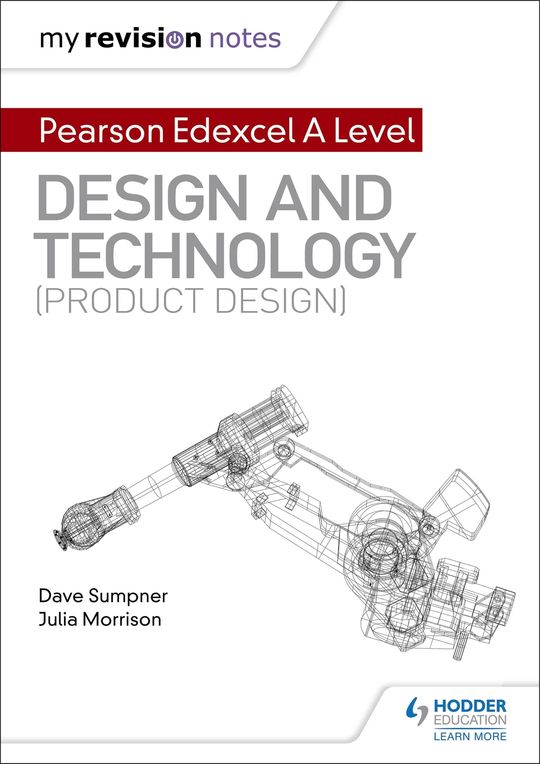
My Revision Notes: Pearson Edexcel A Level Design and Technology (Product Design)
US$ 33.59
The publisher has enabled DRM protection, which means that you need to use the BookFusion iOS, Android or Web app to read this eBook. This eBook cannot be used outside of the BookFusion platform.
Description
Contents
Reviews
Language
English
ISBN
9781510474222
Cover
Titlepage
Copyright
Get the most from this book
My revision planner
1 Materials
1.1 Woods
Hardwoods
Softwoods
1.2 Metals
Ferrous metals
Non-ferrous metals
Alloys (ferrous and non-ferrous)
1.3 Polymers
Thermoplastics
Thermosetting plastics
Elastomers
1.4 Composites
Carbon fibre (CFRP)
Glass fibre (GRP)
Medium Density Fibre Board (MDF)
Hardboard
Chipboard
Plywood
1.5 Papers and boards
Drawing papers
Commercial printing papers
Boards
1.6 Textiles
Natural fibres
Manmade fibres
Textile treatments
1.7 Smart and modern materials
Thermo-ceramics
Shape memory alloys (SMA)
Reactive glass
Liquid crystal displays (LCD)
Photo-chromic materials
Thermo-chromic materials
Quantum tunnelling composites
2 Performance characteristics of materials
Properties of materials
Woods
Metals
Polymers
Smart and modern materials
Papers and boards
Textiles
Composites
3 Processes, techniques and specialist tools
3.1 Processes, techniques and specialist tools
Heat treatments
Alloying
Printing
Casting
Machining
Moulding
Lamination
Marking out techniques
3.2 Application of specialist measuring tools and equipment
Marking, cutting and mortise gauges
Odd leg, internal and external callipers
Squares
Micrometer and vernier callipers
Densitometer
Dividers
Jigs and fixtures
Go/no-go gauges
3.3 Use of media to convey design decisions, to record to recognised standards, explain and communicate information and ideas
Pictorial drawing methods for representing 3D forms
Working drawings for communicating 2D technical information
Nets (developments) for communicating information about 3D forms in a 2D format
Translation between working drawings, pictorial drawings and nets (developments)
Report writing
3.4 Permanent and semi-permanent joining techniques
Adhesives
Mechanical
Heat
Jointing
3.5 Finishing techniques and methods of preservation
Paper and board finishing process
4 Digital technologies
Computer-aided design (CAD)
Computer-aided manufacture (CAM) and rapid prototyping
5 Factors influencing the development of products
5.1 User centred design
User needs, wants and values
5.2 Anthropometrics and ergonomics
Sources and applications of anthropometric data
Ergonomic factors for a designer to consider
5.3 The influence of aesthetics, ergonomics and anthropometrics on the design, development and manufacture of products
Form over function
Form follows function
5.4 Design theory through the influences and methods of the key historical movements and figures
Key historical movements and figures
6 Effects of technological developments
6.1 Current and historical technological developments that have had an effect on the work of designers and technologists and their social, moral and ethical impacts
Mass production
The ‘new’ industrial age of high-technology production
The global marketplace
7 Safe working practices, potential hazards and risk assessment
Understanding safe working practices for yourself and others when designing and making
Understanding the need for risk assessments
8 Features of manufacturing industries
8.1 Methods of production
One-off production
Batch production
High-volume production
8.2 Quality monitoring systems
Quality control (QC)
Quality assurance (QA)
Total Quality Management (TQM)
Quality standards
8.3 Modern manufacturing methods and systems when designing for manufacture for small, medium and large-scale production
Production scheduling and production logistics
Robotics in production
Materials handling systems
Flexible manufacturing systems (FMS), modular/cell production systems
Lean manufacturing using just-in-time (JiT) systems
Standardised parts, bought-in components
Quick response manufacturing (QRM)
Data integration
Concurrent manufacturing
9 Designing for maintenance and the cleaner environment
9.1 ‘Cleaner’ design and technology – a product’s life cycle and sustainable development issues
Material selection
Manufacture
Distribution
Use
Repair and maintenance
End of life
9.2 The wider issues of using cleaner technologies
Cost implications to the consumer and manufacturer
Sustainability
10 Current legislation
10.1 Consumer rights legislation
Consumer Rights Act (2015)
Sale of Goods Act (1979)
10.2 Health and safety laws and regulations
Health and safety regulations
Health and Safety at Work Act (1974)
Control of Substances Hazardous to Health (COSHH) regulations
11 Information handling, modelling and forward planning
11.1 Collection, collation and analysis of information
Marketing
Innovation management
Feasibility studies
11.2 Modelling the costing of projects
Budgets
Planning for production
Selection of appropriate tools, machines and manufacturing processes
11.3 Protecting the intellectual property rights of designers, inventors and companies
Patents
Copyrights
Design rights
Trademarks
11.4 Standards when developing designs and manufacturing products
British Standards (BSI and Kitemark)
European (CEN and CE)
International Standards (ISO)
Other standards labels
12 Further processes and techniques
12.1 Strategies, techniques and approaches to explore, create and evaluate design ideas
User-centred design (UCD)
Circular economy
Systems thinking
12.2 Project management strategies
Critical path analysis (CPA)
Scrum
Six Sigma
12.3 The stages of a product’s life cycle
Stages of the PLC
Additional issues related to PLC
Success in the exam
Tips on preparing for the exam
Command words
Command words
Sample exam questions
Calculations questions
Short-open questions
Open-response questions
Extended-writing questions
Exam practice questions
Now test yourself answers
Exam practice answers
Glossary
Loading...