

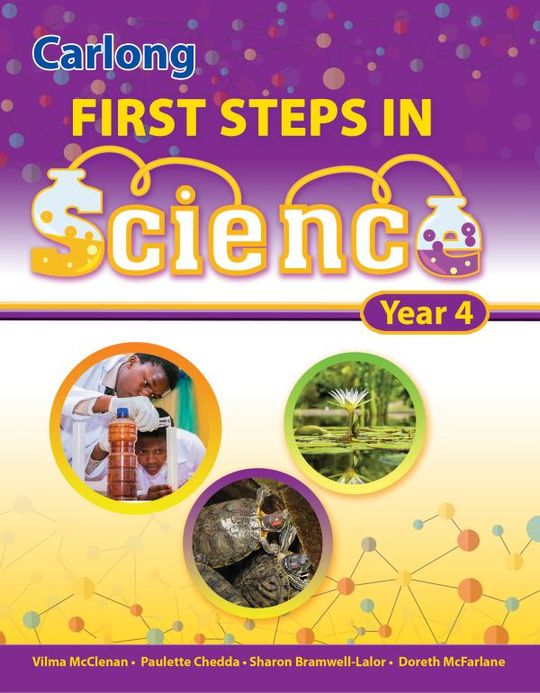
Carlong First Steps in Science – Year 4
US$ 23.00
The publisher has enabled DRM protection, which means that you need to use the BookFusion iOS, Android or Web app to read this eBook. This eBook cannot be used outside of the BookFusion platform.
Description
Contents
Reviews
Language
English
ISBN
978-976-638-262-9
Carlong First Steps in Science - Year 4 Cover
Preliminary pages
Contents
Note to the Teacher
Note to the Student
Acknowledgements
Unit 1: Exploring Science
What is science?
Why should you learn science?
Science process or inquiry skills
What is a scientific method?
The Engineering Design Process
Developing Good Attitudes and Habits of Mind
End of Unit Test
Unit 2A: Living Things
Is it living or non-living?
Where do living things live?
A variety of plants and animals
Unit 2B: The Needs of Living Things
The basic needs of all living things
What do plants need to grow?
Building some plant habitats
The needs of animals
End of Unit Test
Unit 3A: Flowering Plants
What is a flowering plant?
Some common flowering plants
Form and function of roots
Finding out the functions of roots
The shoot of flowering plants
The importance of leaves
The parts of flowers
Unit 3B: Animals Around Us
Some animal habitats
A closer look at some animals
Comparing animals
What is adaptation?
Looking inside animals
Inside a fish and an insect
End of Unit Test
Unit 4A: Sense Organs
Sensing our environment
Organs in an organism
Sense organs and the brain working together
Sense organs working together
Eyes and ears of other animals
Unit 4B: The Structure of Sense Organs
Looking at the human eyes
Looking at a cow’s eye
Using technology to find out about the eye
Looking inside the human eye
Can our eyes mislead us?
The ear
Your nose knows!
The tongue and tasting
Looking at the skin
Using technology to extend the senses
Unit 4C: Taking Care of the Sense Organs
The eyes
The ears
Taking care of other sense organs
Taking care of your skin
End of Unit Test
Unit 5: Introduction to Materials
What does ‘material’ mean in science?
What are some properties of materials?
Common objects and materials that make them
Why are the properties of materials important?
Classifying materials
Matter and materials
End of Unit Test
Unit 6A: Water
The nature of water
How does water behave?
The forms of water
Why is water important?
Unit 6B: Where Does Water Come From?
From where do you get water for your use?
The origin of water
Conserving water
Water pollution
What are some effects of water pollution?
Common water-borne diseases
How can you prevent or reduce water pollution?
Purifying water
How can you disinfect water for domestic use?
Unit 6C: Air Around Us
What are some properties of air?
What is air?
Uses of air
Unit 6D: Air Pollution
What is air pollution?
How can you reduce or prevent air pollution?
Reducing air pollution
What are the general effects of air pollution?
What are some airborne diseases?
End of Unit Test
Glossary
Loading...

$14.57
Interactive


$9.99
Video


